

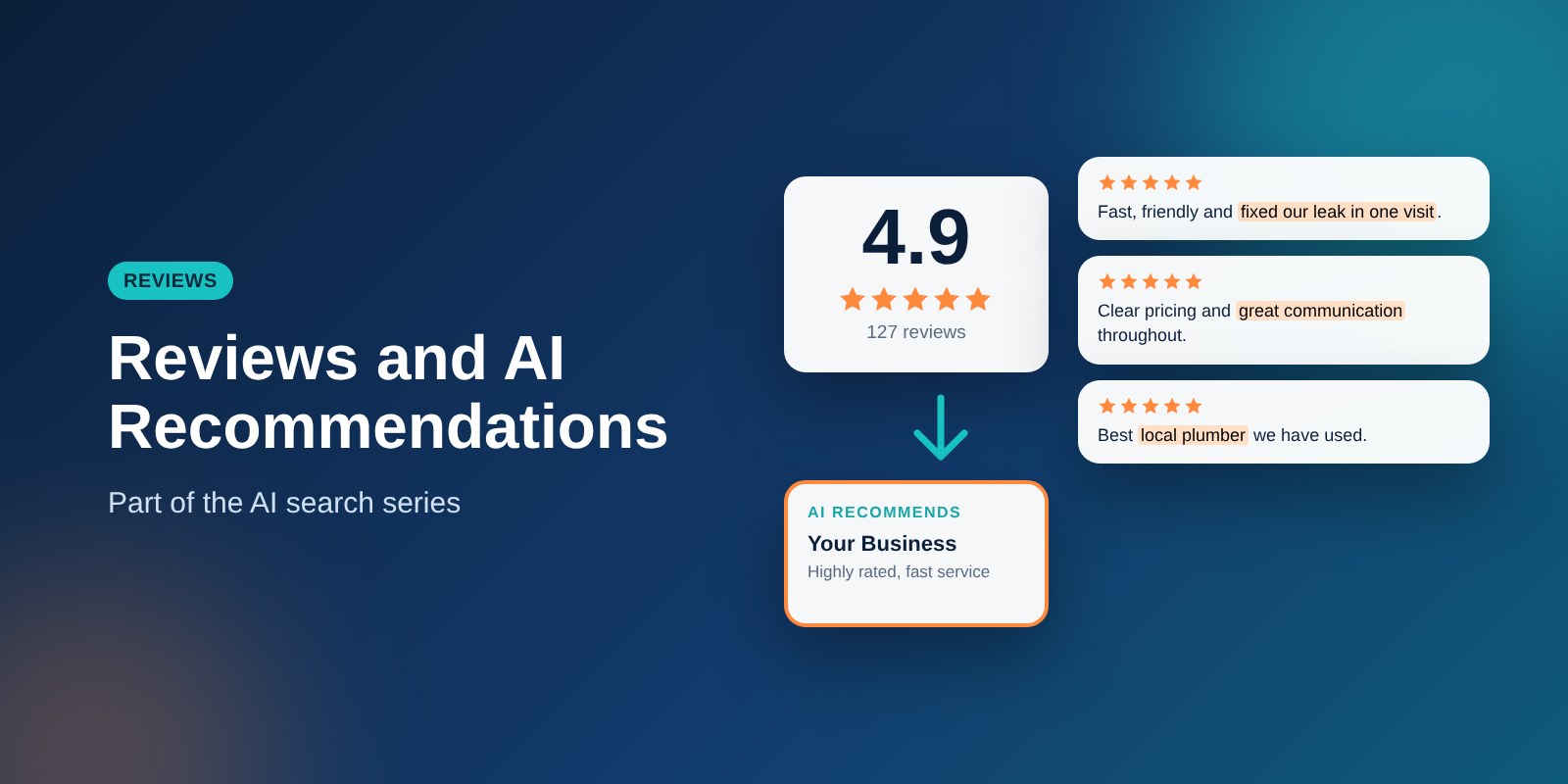
Reviews are some of the most useful evidence an AI tool can find about a business. They are written by customers, they describe real jobs, and they are easy to compare across companies. A business with many detailed, recent reviews gives an AI far more to work with than one with a handful of star ratings.
This post explains why reviews matter for AI recommendations, how to earn better ones, and how to use them without crossing any lines.
Why reviews matter for AI answers
When someone asks an AI tool “is this company any good” or “who is the best electrician near me,” the tool looks for evidence. Your own website says what you want people to believe. Reviews show what customers experienced.
No one outside the AI companies knows exactly how reviews are weighted, and each product works differently. Some draw on local data such as Google Business Profile, some summarize review sites, and some read forum discussions. The safest assumption is that review text in public places can be read and summarized.
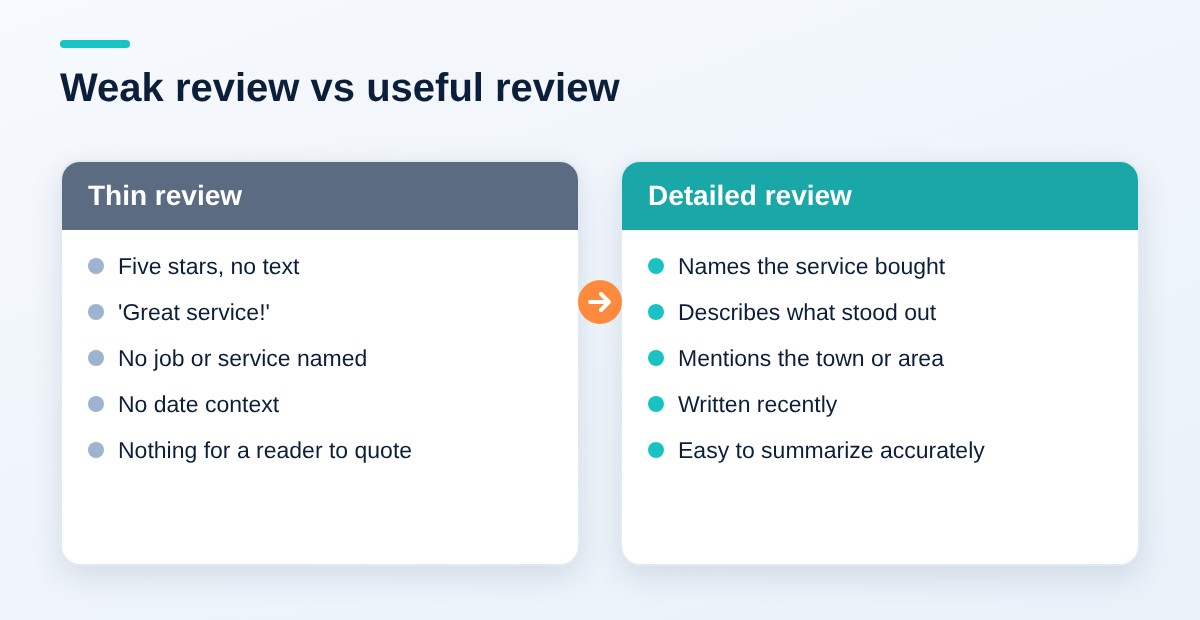
That has a practical consequence. A star rating is a number. A review that says “they arrived within an hour, found a cracked valve and explained the repair before starting” is a description a tool can reuse.
What makes a review useful
- Specifics: the service, the outcome and the people involved.
- Recency: a steady flow beats a burst from two years ago.
- Volume and spread: reviews across Google and the platforms your industry uses.
Specifics are the part most businesses miss. A review that says “great service” tells a reader and a machine almost nothing. A review that names the job, the town and what went well gives them something to quote.
Where reviews live
Do not rely on a single platform. Spread matters because different customers and different AI tools look in different places.
| Source type | Examples (generic) | Why it matters |
|---|---|---|
| Maps and local profile | Google Business Profile | Often the first place local customers look |
| Industry platforms | The main review site for your trade or niche | Carries weight with buyers in your field |
| Social and community | Facebook page, neighborhood groups, forums | Informal comments are public text too |
| Your own site | Testimonials on service pages | Gives context next to what you offer |
How to ask in a way that gets detail
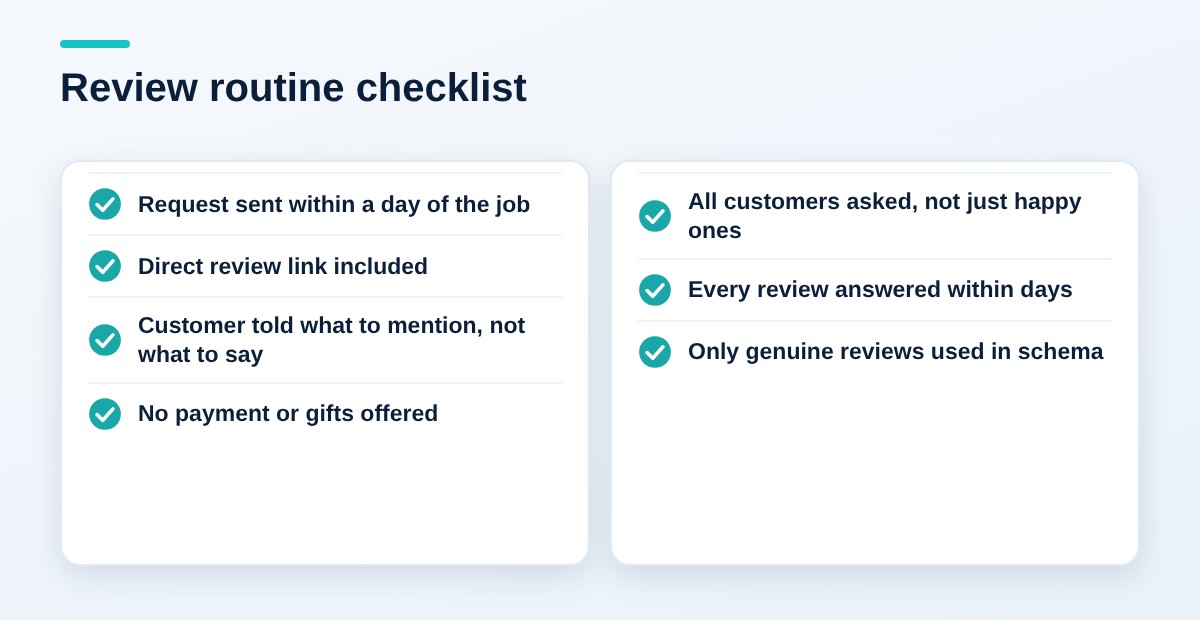
- Ask right after a successful job, while the experience is fresh.
- Send a direct link to your review page by text or email.
- Suggest what to mention, such as the service they bought and what stood out, without scripting the review.
- Make it a routine step in your process, not an occasional push.
A sample request message
Here is a generic example a service business could adapt: “Thanks for choosing us today. If you have a minute, a short review helps other people in town find a reliable provider. It is useful if you mention what we did for you and anything that stood out. Here is the link.”
The message is open about why you are asking, makes no demand about what the review should say, and gives the customer a clear next step.
Build it into your routine
- Add the request to the invoice email or the job-completion checklist.
- Assign one person to send requests the same day.
- Keep a short tracking sheet so no customer is missed or asked twice.
- Aim for a steady pace each week rather than a large batch.
Stay within the rules
Do not offer payment or gifts in exchange for reviews, and don’t gate requests to reach only happy customers. Review platforms prohibit this, and the penalties can be harsh.
The US Federal Trade Commission also has rules on reviews. Its staff guidance says businesses can’t write, buy or sell fake reviews, can’t make an incentive depend on a positive sentiment, and can’t use threats or intimidation to suppress reviews. Read the details in the FTC questions and answers on its consumer reviews rule, and check each platform’s own policy before you run a request campaign. This is not legal advice.
Respond to every review
Thank positive reviewers and mention the service by name where natural. Reply to negative reviews calmly, state the facts, and describe how you fixed or will fix the problem. Your replies are public text that AI tools can read too.
A simple response structure
- Thank the customer by first name.
- Refer to the specific job or issue.
- For a complaint, acknowledge the problem without arguing.
- State what you did or will do, and offer an offline contact.
Avoid copy-pasted replies. Ten identical responses read as automated to people, and likely to machines too.
Use reviews on your own site
- Show real testimonials on service pages, with the customer’s first name and the town if they agree.
- Add review schema only for genuine reviews displayed on the page.
- Don’t copy reviews that don’t belong to you or invent them.
Match testimonials to the page. A testimonial about a kitchen remodel belongs on the kitchen remodel page, where it supports the claim you are making there.
Handling negative reviews
A few negative reviews are normal and can make a profile look more believable. What matters is the pattern and your response.
- Respond within a couple of days, not weeks.
- Take real fixes seriously. If three reviews mention the same problem, change the process.
- Report reviews that break platform policy, such as spam or reviews about the wrong business, using the platform’s own tools.
- Never argue, reveal private customer details or threaten the reviewer.
Common mistakes
- Asking only after a great day. This creates gaps and can drift into gating.
- Relying on one platform. A single profile leaves you exposed to changes you do not control.
- Ignoring replies. Unanswered reviews, good or bad, are missed text.
- Burst campaigns. Fifty reviews in one week followed by silence looks unnatural.
- Marking up reviews that are not shown. Schema should reflect what visitors can see.
How to measure progress
Track a few simple numbers each month: new reviews received, the share of customers asked, average response time to reviews, and how many new reviews name a specific service. Over a quarter, these show whether your process works.
Also add review wording to your prompt test. Ask AI tools what customers say about your business, and compare the answer with what your real reviews say. Gaps show what to ask customers to mention.
Where to start this week
- Read your last 20 reviews and list what customers mention most, including complaints.
- Write a short, neutral review request message and save it as a template.
- Add the request to the end of your job or order process.
- Reply to every review from the last 60 days that has no response.
- Add a few real testimonials to your most important service page.
Key takeaways
- Detailed, recent reviews give AI tools real evidence to work with.
- Ask every customer, soon after the job, with a direct link and no scripting.
- Never pay for, fake or selectively gate reviews.
- Reply to all reviews; your replies are public text too.
- Use only genuine reviews on your own site and in schema.
- Consistent effort over months beats a short burst.
Related: AI Search for Business: How to Get Found in ChatGPT, Google AI Overviews and Perplexity
Want to see where your business stands in AI answers today? Contact SEO Now for an AI search visibility review.