

SEO Marketing vs. AI Marketing In 2026
WHY THIS COMPARISON MATTERS
Most teams are asking the wrong question. The real choice is not whether SEO is over or whether AI has replaced search. The real choice is whether your content is being prepared for both kinds of discovery: the traditional search results page and the newer answer layer created by AI systems.
For most of the web era, discoverability meant ranking a page, earning a click, and converting the visitor after they landed on your site. That model still matters. But people now move fluidly between search engines and conversational tools. In those environments, a brand can be surfaced not only as a blue link, but also as a cited source, a supporting reference, a summary, a recommended page, or an answer fragment inside a larger response.
In this article, “marketing for AI” does not mean using AI to write ads or automate campaigns. It means shaping content so AI-powered products such as Google AI Overviews, Google AI Mode, ChatGPT Search, and Microsoft Copilot can understand, select, cite, and present your information accurately. The practical takeaway is simple: SEO remains the foundation, while AI optimization changes how that foundation is packaged, retrieved, and referenced.
WHAT SEO MARKETING MEANS
SEO marketing is the disciplined work of making a site easier for search engines to crawl, index, understand, rank, and present to users. That includes technical hygiene, internal linking, metadata, page experience, structured data where appropriate, and content that directly satisfies search intent. Google’s SEO Starter Guide still frames this work around making content easier for search engines and users to understand.
Its commercial strength comes from repeatability. You can build topic clusters, improve rankings, monitor impressions and clicks, connect pages to business outcomes, and turn organic search into a durable acquisition channel. In mature programs, SEO is not just about keywords. It becomes a publishing, information architecture, and demand-capture system.
WHAT AI MARKETING MEANS IN PRACTICE
AI marketing, in the sense relevant here, is optimization for answer engines and assistants. Instead of focusing only on whether a page can rank in a list of results, it focuses on whether a piece of content can be extracted, trusted, cited, and woven into an answer.
That changes the operating model. The winning unit is no longer just the whole page. It can also be the passage, table, list, FAQ block, product attribute, policy statement, statistic, or comparison point that an AI system can reuse with confidence. Strong AI-focused optimization usually means cleaner structure, more explicit language, better entity clarity, fresher data, and tighter alignment between what the page promises and what it actually delivers.
Importantly, this is not a total break from SEO. Google explicitly says SEO best practices remain relevant for AI features in Search and that there are no additional requirements to appear in AI Overviews or AI Mode. Its guidance on helpful, reliable, people-first content reinforces the same idea. That is why the smartest strategy is not to split SEO and AI into separate silos, but to treat AI visibility as an additional layer of optimization built on top of search fundamentals.
WHERE SEO AND AI MARKETING OVERLAP
The overlap between the two is larger than the debate online often suggests. Both disciplines reward the same underlying habits:
- Accessible, indexable content. If a crawler cannot reach the page or understand its main content, neither classic search nor most AI discovery workflows can use it reliably.
- Helpful, original information. Search systems and answer systems both perform better when the page offers something specific, trustworthy, and actually useful to a visitor, which aligns with Google’s helpful, reliable, people-first content guidance.
- Clear structure. Headings, lists, tables, and well-labeled sections help search engines interpret pages and help AI systems extract reusable answer components.
- Consistency of meaning. Titles, headings, descriptions, visible content, and structured data work best when they point to the same core topic instead of sending mixed signals.
- Continuous iteration. Both SEO and AI visibility improve when marketers update important pages, refine weak sections, and measure performance over time rather than publishing once and walking away.
THE BIGGEST DIFFERENCES
The similarities matter, but the differences matter more when you are deciding how to allocate budget, content effort, and reporting. A useful way to think about it is this: SEO tries to win a position in the result set, while AI optimization tries to win selection inside the answer. That framing matches Microsoft’s guidance on inclusion in AI search answers, OpenAI’s rollout of ChatGPT search, and the earlier SearchGPT prototype announcement.
Side-by-Side Comparison of SEO Vs. AI Marketing
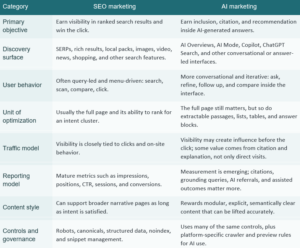
BENEFITS SEO STILL DELIVERS BETTER THAN ANYTHING ELSE
SEO remains the strongest long-term visibility asset because it compounds. A page that earns trust, links, and relevance can continue to attract qualified traffic long after the original publishing date. That makes SEO especially valuable for evergreen education, category pages, feature pages, documentation, and high-intent commercial content.
It is also the more mature operating environment. Search tools and workflows are well established, reporting is more standardized, and the path from impression to click to on-site conversion is easier to track. For many organizations, that maturity is a strategic advantage because it makes budgeting, forecasting, and governance easier.
There is another reason SEO still matters even if AI discovery grows fast: answer systems are not replacing the web’s technical foundations. They still depend on crawlable, high-quality source material. That logic is reflected in both Google’s SEO Starter Guide and the Bing Webmaster Guidelines. If your SEO foundation is weak, your AI visibility is usually weak too.
BENEFITS OF OPTIMIZING FOR AI DISCOVERY
AI-focused optimization matters because discovery is moving upstream into conversational interfaces. People ask longer, more specific questions, and then refine those questions through follow-ups. A brand that appears only after the user clicks ten links is arriving later in the journey than a brand that is cited in the first answer.
This environment can also reward a wider range of sources. Google says AI experiences can show a broader and more diverse set of supporting links than classic web search. That creates opportunity for pages that may not dominate every head term but are exceptionally clear on a narrower subtopic, use case, or comparison point.
For marketers, AI visibility also creates a new kind of brand effect. Even when the click does not happen immediately, being cited inside an answer can shape trust, recall, and consideration earlier in the decision process. In other words, AI optimization is not only about traffic capture. It is also about being part of the explanation.
MEASUREMENT AND REPORTING
Measurement is one of the biggest operational differences between SEO and AI marketing. Traditional SEO still revolves around well-known metrics such as indexed pages, impressions, average position, click-through rate, sessions, assisted conversions, and revenue from organic traffic.
AI marketing introduces additional signals. Microsoft has started exposing citation-level reporting in Bing Webmaster Tools, including total citations, average cited pages, grounding queries, and page-level citation activity. That is a meaningful shift because it acknowledges that visibility in AI systems is not identical to ranking in a link list.
Google’s reporting is evolving too. Its Performance report documentation and guidance on AI Mode traffic in overall performance totals show that AI visibility is beginning to surface inside existing measurement workflows. In practice, that means marketers should stop relying on a single metric. The right dashboard now blends classic search KPIs with source-citation patterns, AI referral traffic, branded search lift, and conversion quality on pages that are frequently referenced by assistants.
CONTROLS, GOVERNANCE, AND PREVIEW STRATEGY
One reason the SEO versus AI discussion becomes confusing is that many people assume AI visibility is uncontrollable. That is not really true. Site owners still have policy and preview levers. Google applies preview controls such as nosnippet, data-nosnippet, max-snippet, and noindex to AI features in Search, and it also documents subscription and paywalled content markup. Bing now supports data-nosnippet for AI-generated answers and has published guidance for webmaster control in Bing Chat.
OpenAI has likewise documented crawler controls, including OAI-SearchBot and GPTBot. The big strategic lesson is that brands should decide intentionally what they want indexed, previewed, summarized, or withheld. Governance is no longer just a legal or technical afterthought; it is part of discoverability strategy.
OTHER CATEGORY THAT MATTERS: RISK AND TRADEOFFS
Every channel has tradeoffs. SEO can be slow, heavily competitive, and vulnerable to ranking shifts that compress click-through rate even when visibility holds. AI-focused discovery has a different set of risks: attribution is less mature, presentation is less controllable, and the assistant may summarize your content in ways that reduce nuance unless your page is exceptionally clear.
The operational answer is not to avoid AI discovery. It is to reduce ambiguity. Decide which pages should be widely previewed, which elements should be excluded from previews, and which claims require tighter sourcing or more frequent refresh cycles. Teams that treat governance, editorial standards, and technical controls as part of the content workflow will adapt faster than teams that treat AI visibility as a black box.
A PRACTICAL CONTENT PLAYBOOK FOR BOTH
The most resilient content strategy is to create pages that perform well in both environments. Start by aligning the page title, H1, and description so the page’s purpose is unmistakable. Then organize the page with direct headings that reflect real questions or subtopics, not vague labels.
Make important answers easy to lift. Put concise, self-contained explanations near the top of relevant sections. Use tables when users need comparisons. Use numbered steps when the task is sequential. Use FAQ-style blocks when people repeatedly ask the same thing in natural language. In AI systems, extractability is a competitive advantage.
Keep critical information in HTML, not only in images, PDFs, or collapsed interface elements. Add structured data markup where it genuinely fits, and make sure it matches what the visitor can see on the page. Support claims with evidence, examples, and specifics. Refresh aging pages before they become stale, especially when facts, product details, policies, regulations, or feature sets change.
Finally, think beyond text. Google’s advice on content that performs well in AI experiences emphasizes multimodal support, and its video SEO best practices reinforce the same idea for publishers. Local businesses and commerce brands should keep business, product, and feed information current because AI systems increasingly answer questions that blend web content with entity and platform data.
COMMON MISTAKES TEAMS MAKE
The first mistake is treating AI optimization as a replacement for SEO. That usually leads to shallow experiments that ignore crawlability, architecture, canonicals, and content quality. The second mistake is flooding a site with AI-generated pages that add little value. Google’s guidance on generative AI content on your website is clear that scaled content without user value can create problems.
A third mistake is writing copy that sounds polished but says very little. AI systems do not just reward tone. They reward clarity, specificity, structure, and evidence. Pages built around vague claims, hidden information, and generic headings are harder for both people and machines to trust.
The fourth mistake is measuring only last-click traffic. In AI-mediated discovery, influence can happen before the visit. If your team ignores citations, branded lift, assisted conversions, and high-intent downstream behavior, it may underinvest in content that is already helping the business.
Final Takeaway
The most practical conclusion is not that one discipline will replace the other. SEO is still the infrastructure layer for organic discovery. AI marketing is the selection layer that influences how your content gets represented inside machine-generated experiences.
If your pages cannot be crawled, indexed, and trusted, AI systems will struggle to use them well. If your pages are technically sound but vague, bloated, or hard to extract from, rankings alone may not translate into strong AI visibility. The winning approach is to build useful pages that are structurally clean, evidence-backed, current, and easy to understand in small units as well as in full-page form.
That is why the future is not SEO versus AI. It is SEO plus AI-ready content design, plus smarter measurement, plus more intentional control over how your brand is surfaced across the discovery stack.