

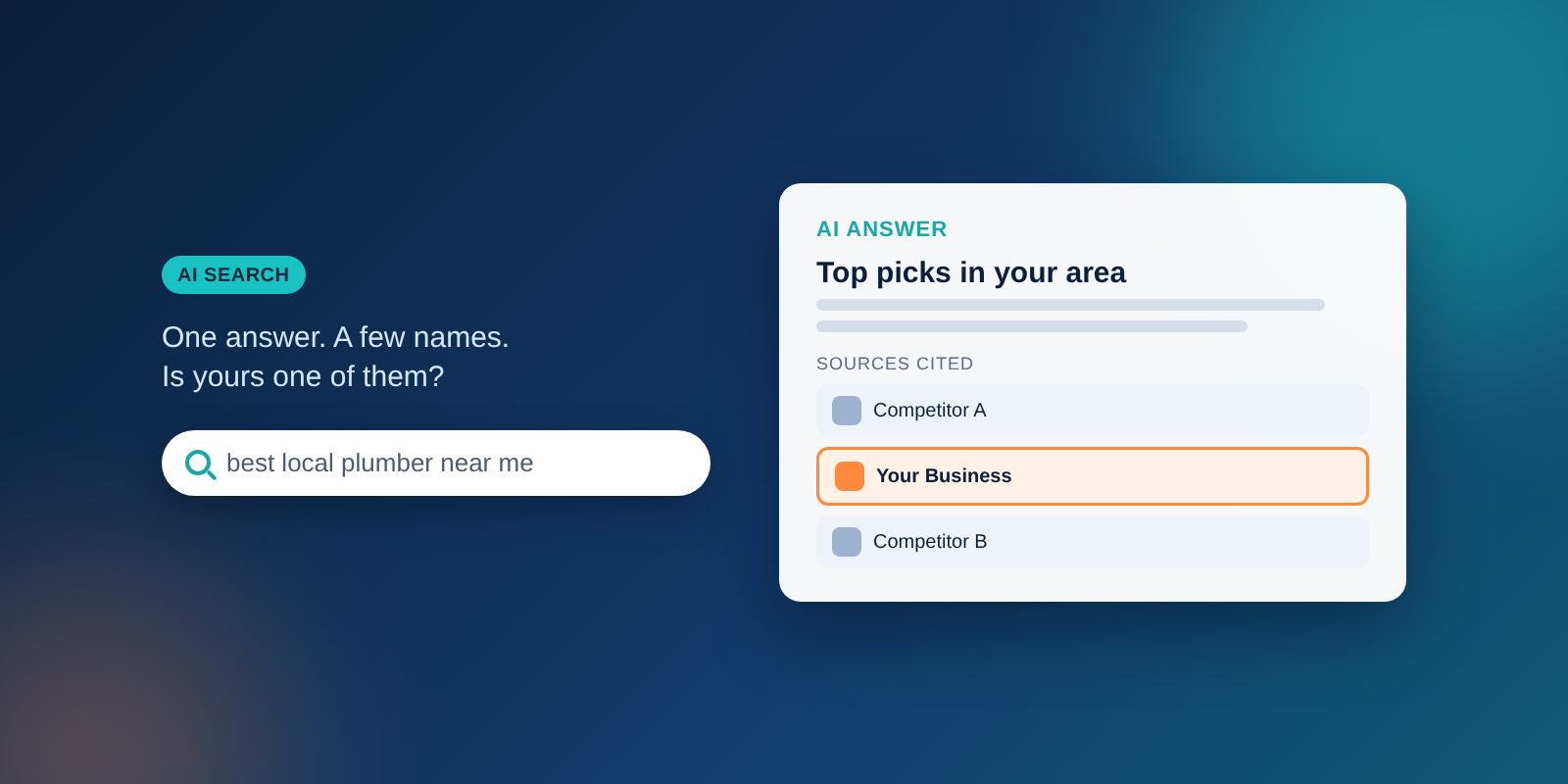
Your next customer may never see a list of ten blue links. They’ll ask ChatGPT, Google’s AI Overview or Perplexity a question, get one written answer, and call the one or two businesses it names.
That shift is already happening, and it changes what “being found” means. If an AI tool doesn’t know who you are, or doesn’t trust you enough to mention you, you’re invisible at the exact moment someone is ready to buy. This post explains how AI search works, how it differs from the SEO you already know, and the steps that make a business show up in those answers.
What AI search is
AI search tools answer a question in plain language instead of handing you a list of links. They read many web pages, pull out the relevant facts, and write a short answer, usually with a few sources cited underneath.
The ones your customers are using today:
- Google AI Overviews and AI Mode: AI-written answers at the top of Google results, or in a chat-style tab.
- ChatGPT search: OpenAI’s assistant, which browses the web when a question needs current information.
- Perplexity: an answer engine that shows its sources next to every claim.
- Gemini, Microsoft Copilot and Claude: assistants that can also search the web and recommend businesses.
Each one picks its sources differently, so being cited by one doesn’t guarantee being cited by the others.
How AI search differs from traditional SEO
Traditional SEO fights for a position in a list. AI search fights for a mention inside an answer, and the click often never happens.
| Traditional search | AI search | |
|---|---|---|
| What the user gets | Ten links to compare | One written answer with a few cited sources |
| What you compete for | Ranking position | Being named or cited in the answer |
| What the engine trusts | Links, relevance, page experience | Clear facts, consistent mentions across the web, reviews and structured data |
| Result of success | A click to your site | A mention, sometimes a click, often a phone call or a branded search later |
The click loss is measurable. About 68% of US searches ended without a click to the open web in 2026 (Similarweb, via SparkToro). Pew Research found people clicked a traditional result in 8% of sessions with an AI Overview versus 15% without. The same roundup reports that pages cited in an AI Overview earn more clicks per impression than uncited pages on the same results page, so being named in the answer is the new way to hold your share.
This doesn’t replace SEO. The pages that rank still feed these answers. It adds a second job: making your business easy for a machine to understand, verify and quote.
How AI engines choose who to cite
Nobody outside the AI companies knows the exact formula, but published studies point to the same pattern: the engines favor businesses that are mentioned often, described consistently and easy to quote.
- Brand mentions beat backlinks. Ahrefs found branded web mentions correlate with AI Overview appearances at 0.664, versus 0.218 for backlinks.
- Page-one rank isn’t required. WordStream reports about 40% of AI Overview sources rank outside the top 10 organic results.
- Each engine cites differently. Profound found 89% of citations differ between ChatGPT and Perplexity, so you need presence across several sources, not one page.
- Third-party sources matter. Reddit, YouTube, Wikipedia and review sites show up heavily in citation studies, which means what others say about you counts as much as your own site.
- Clear, structured answers win. Pages that state a fact plainly, in a heading and a short paragraph, are easier to lift into an answer than long, vague copy.
These figures come from third-party studies of different engines and time periods, so treat them as direction, not rules.
What to do about it
Start with the work that helps both traditional and AI search, then add the AI-specific pieces.
- Answer real customer questions on your site. Build pages around the exact questions people ask, like “how much does X cost in [city]” or “what should I look for in a Y provider.” Put the answer in the first two sentences under a clear heading.
- Make your business facts consistent everywhere. Name, address, phone, services and hours should match across your site, Google Business Profile, and directories. Conflicting details make an AI tool less likely to trust and name you.
- Earn reviews and mentions off your own site. Ask customers for detailed Google reviews, pursue local press, partner pages and industry directories, and take part where your customers talk, such as Reddit and local forums.
- Add structured data. Use schema markup for your business, services, FAQs and reviews so machines can read your facts without guessing.
- Keep your best pages fresh. Update pricing, dates and statistics on the pages you want cited, and show the update date.
- Let AI crawlers in. Check your robots.txt and firewall settings. Blocking the crawlers that ChatGPT, Perplexity and Google use can keep you out of their answers entirely.
- Show real expertise. Name the author, include credentials and cite your sources. Original data, case studies and local detail are hard for an AI to get anywhere else.
None of this is a trick. It is the same advice good SEO has always given, done more completely and checked against how AI tools read the web.
How to measure AI visibility
Rankings alone won’t show you this, so track a few different signals.
- Prompt tests: each month, ask ChatGPT, Perplexity, Gemini and Google AI Mode the 15 to 20 questions your customers ask, and record whether you are named, cited or missing.
- Referral traffic: in Google Analytics, look for visits from chatgpt.com, perplexity.ai and similar sources.
- Branded search: a rise in people searching your business name often follows a mention in an AI answer.
- Leads: add “How did you hear about us?” to forms and calls, with an option for AI tools.
Keep the same prompt list from month to month so you can compare results. Answers vary from one run to the next, so judge trends, not single tests.
The bottom line
AI search rewards businesses that are clear, consistent and well mentioned across the web, which is what strong SEO has always built. The difference is that the reward is now a name inside an answer, and the businesses that act first will be the ones those answers keep recommending.
Want to know where you stand? SEO Now can test the questions your customers ask across ChatGPT, Google and Perplexity, show you who gets named instead of you, and build a plan to change that. Contact SEO Now for an AI search visibility review.
Sources
- Zero-click search statistics, SearchLogistics: Similarweb/SparkToro zero-click rate and Pew Research click data
- AI search statistics, Exposure Ninja: Ahrefs brand-mention correlation, WordStream and Profound citation data